
Journal of Liberal Arts & Interdisciplinary Sciences

 Search

1Punjab University, Chandigarh, India
2South Asian University, New Delhi, Delhi, India

Creative Commons Non Commercial CC BY-NC: This article is distributed under the terms of the Creative Commons Attribution-NonCommercial 4.0 License (http://www.creativecommons.org/licenses/by-nc/4.0/) which permits non-Commercial use, reproduction and distribution of the work without further permission provided the original work is attributed.
This article analyses the quantity–price relationship using the GDP and the wholesale price data for India for the period 1983–2023. The relationship is, however, assessed not in isolation rather in the broad context of share market functioning and employment growth. The advantage is that we are able to understand the linkages between economic growth and employment growth, on the one hand, and the real sector and financial sector as well. Findings confirm that employment loss resulting in a deceleration in demand can actually retard economic growth. On the other hand, the role of the share market in raising economic growth is nominal. Price is not seen to influence economic growth significantly, and it is difficult to reduce the price even after augmenting production, once it has already shot up. Hence, the price strategy to provide an incentive to the producers must be played carefully. The measurement of core inflation shows that it comprises a significant component of the total price rise, though the core inflation part has come down significantly over the years, unravelling the efficiency of the government in pursuing price management.
Inflation, growth, employment, share market, demand
Aga, M., & Kocaman, B. (2006). Efficient market hypothesis and emerging capital markets: Empirical evidence from Istanbul stock exchange. International Research Journal of Finance and Economics, 6, 123–134.
Almuzara, M., & Sbordone, A. M. (2024). Core inflation: Measurement and policy implications. Federal Reserve Bank of New York Staff Reports, No. 1071. https://doi.org/10.2139/ssrn.4392489
Aoki, K. (2001). Optimal monetary policy responses to relative-price changes. Journal of Monetary Economics, 48(1), 55–80. https://doi.org/10.1016/S0304-3932(01)00067-X
Balakrishnan, P., & Parameswaran, M. (2022). India’s inflation dynamics: Beyond monetary policy. Economic & Political Weekly, 57(42), 36–43.
Ball, L., & Mankiw, N. G. (1994). Asymmetric price adjustment and economic fluctuations. The Economic Journal, 104(423), 247–261.
Barro, R. J. (1995). Inflation and economic growth. Bank of England Quarterly Bulletin, 35(2), 166–176.
Bernanke, B. S., & Gertler, M. (1995). Inside the black box: The credit channel of monetary policy transmission. Journal of Economic Perspectives, 9(4), 27–48.
Bhattacharya, B., & Mukherjee, J. (2002). The relationship between stock prices and the macroeconomic variables: Evidence from India. Indian Journal of Capital Market, 1(2), 14–19.
Blinder, A. S. (1997). Commentary. Federal Reserve Bank of St. Louis Review, 79(3), 157–164.
Bryan, M. F., & Cecchetti, S. G. (1994). Measuring core inflation. In N. G. Mankiw (Ed.), Monetary policy (pp. 195–215). University of Chicago Press.
Clark, T. E. (2001). Comparing measures of core inflation. Economic Review, 86(2), 5–31.
Desai, M. (2011). Price stability and its role in India’s monetary policy. Economic & Political Weekly, 46(34), 45–52.
Dholakia, R. H., Karan, N., & Pandya, M. (2021). Estimating threshold inflation for India [IIMA Working Papers, No. WP2021-03-01. Indian Institute of Management Ahmedabad]. https://doi.org/10.2139/ssrn.3795280
Fama, E. F. (1970). Efficient capital markets: A review of theory and empirical work. The Journal of Finance, 25(2), 383–417. https://doi.org/10.2307/2325486
Fama, E. F. (1981). Stock returns, real activity, inflation, and money. The American Economic Review, 71(4), 545–565.
Fischer, S. (1993). The role of macroeconomic factors in growth. Journal of Monetary Economics, 32(3), 485–512. https://doi.org/10.1016/0304-3932(93)90027-D
Gao, H., & Nicolini, J. P. (2023). The quantity theory of money: Empirical relevance and theoretical developments. Journal of Economic Perspectives, 37(2), 121–146.
Guerrieri, V., Lorenzoni, G., Straub, L., & Werning, I. (2023). Macroeconomic implications of COVID-19: Can negative supply shocks cause inflation? Journal of Economic Perspectives, 37(1), 111–134.
International Monetary Fund. (2025). Regional economic outlook for Asia and Pacific. IMF Publications.
International Monetary Fund. (2025a). World economic outlook.
Ioannidis, C., Katrakilidis, C., & Lake, A. (2005). The relationship between inflation and stock market performance in developed and emerging markets. Applied Financial Economics, 15(13), 1117–1131. https://doi.org/10.1080/09603100500122752
Ioannidis, C., & Kontonikas, A. (2008). The impact of monetary policy on stock prices. Journal of Policy Modeling, 30(1), 33–53. https://doi.org/10.1016/j.jpolmod.2007.06.015
Kannan, R., & Joshi, H. (1998). Growth-inflation relationship: Some evidence from India. Economic and Political Weekly, 33(44), 2789–2794.
Kessel, R. A. (1956). Inflation-caused wealth redistribution: A long-term view. The Review of Economics and Statistics, 38(3), 289–292. https://doi.org/10.2307/1926397
Mankiw, N. G., & Reis, R. (2003). What measure of inflation should a central bank target? Journal of the European Economic Association, 1(5), 1058–1086.
Quah, D. T., & Vahey, S. P. (1995). Measuring core inflation [Bank of England Working Paper No. 31].
Raj, J., Sahoo, M., & Patra, M. D. (2020). Measuring core inflation in India: An empirical assessment [Working Paper Series, No. 01/2020. Reserve Bank of India].
Rangarajan, C. (1998). Development, inflation and monetary policy. Economic & Political Weekly, 33(41), 2631–2635.
Reserve Bank of India. (2025a). Monetary policy statement. RBI Publications.
Reserve Bank of India. (2025b). Governor’s remarks at the International Monetary Fund. RBI Publications.
Sreenu, M. (2023). Impact of inflation on stock returns in India: An empirical analysis. Journal of Risk and Financial Management, 16(2), 91. https://doi.org/10.3390/jrfm16020091
Tiwari, A. K., Shahbaz, M., & Islam, F. (2019). Does inflation hamper economic growth? New evidence from the threshold effect model for India. Economic Analysis and Policy, 62, 221–230. https://doi.org/10.1016/j.eap.2019.03.003
Tobin, J. (1972). Inflation and unemployment. American Economic Review, 62(1/2), 1–18.
Zhang, Y. (2021). Inflation and stock market performance: A global perspective. International Review of Financial Analysis, 78, 101974. https://doi.org/10.1016/j.irfa.2021.101974
Appendix
VAR Diagnostic Tests
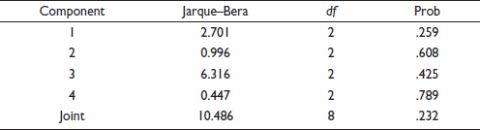
Normality test
Residuals serial correlation LM test

Heteroskedasticity test (includes cross terms)

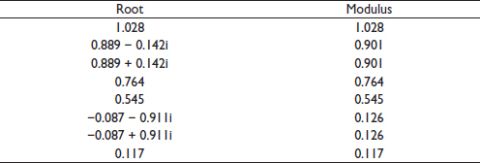
AR inverse roots
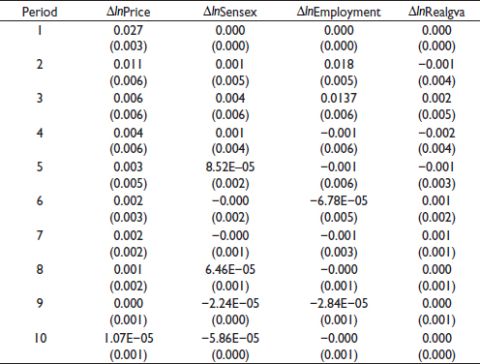
Impulse Response Function
Effect of Cholesky one SD.  Price Innovation (i.e., response of different variables to price shock)
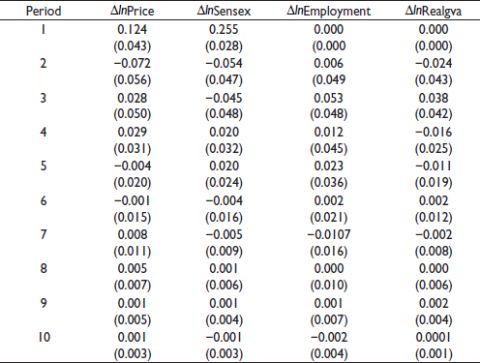
Effect of Cholesky one SD. Sensex Innovation (i.e., response of different variables to share market shock)
Effect of Cholesky one SD. Employment Innovation (i.e., response of different variables to employment shock)
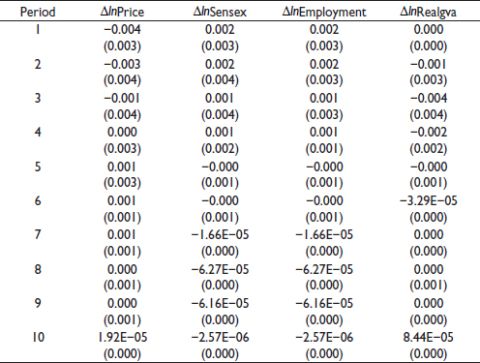
Effect of Cholesky one SD. Realgva Innovation (i.e., response of different variables to value-added shock)
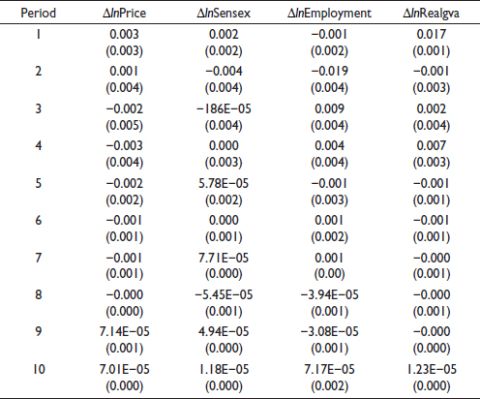
Regression of price growth on its lagged values:
Price = 0.032924 + 0.491404Price (−1) −0.075476Price (−2) (2.87)* (2.79)* (−0.43)
t ratios in parentheses: *Significant at the 5% level. AIC = −4.01
